
Quick summary
Dyslexia primarily affects reading fluency, spelling, working memory, and processing speed — not intelligence. It remains substantially under-diagnosed in higher education, so accessible design should be built into every course, not offered only on individual request.
At a glance: common challenges
- Dense reading lists and cluttered digital text
- Timed exams penalise processing speed, not subject knowledge
- Heavy, unscaffolded writing demands under time pressure
- Frequent non-disclosure due to stigma
At a glance: quick strategies
- Use sans-serif fonts, left-aligned text, good contrast
- Structure and prioritise long reading lists
- Give clear marking criteria in writing
- Offer extra time and format flexibility as standard
1. Introduction and Overview
Dyslexia is a common, lifelong learning difference primarily affecting reading fluency, spelling, and working memory, though it does not affect intelligence or academic potential. Dyslexia remains substantially under-diagnosed in higher education, and many students who reach university with an undiagnosed or undisclosed dyslexia profile have developed effective coping strategies that can mask ongoing difficulty with dense text, timed assessment, and organisation.
This chapter draws on institutional guidance on barriers faced by dyslexic students, real-world examples of UK universities addressing these barriers, and the Kiran persona and associated Accessible Academy guidance, adapted for the Uzbekistan HE context.
Why this matters
2. Understanding the Disability
What dyslexia is
- Dyslexia primarily affects reading fluency, spelling, and phonological processing, and often working memory and organisational skills as well.
- It exists on a spectrum of severity and can co-occur with other conditions such as ADHD or dyspraxia.
- Dyslexia is not linked to intelligence: many dyslexic students are high-achieving and have developed strong compensatory strategies, which can make the underlying difficulty less visible to staff.
Common misconceptions
- That dyslexia is simply about reversing letters or reading slowly: the underlying difficulty is with phonological processing and working memory, which affects far more than reading speed.
- That a student who writes well or speaks articulately cannot be dyslexic: many dyslexic students compensate strongly in some areas while still struggling significantly with, for example, timed writing or dense unstructured text.
- That dyslexia will always have been diagnosed by the time a student reaches university: it remains substantially under-diagnosed, and many students never disclose even where a diagnosis exists.
- That accommodations for dyslexia (extra time, assistive software) are a lowering of standards: they address access to demonstrating knowledge, not the standard being assessed.
3. Common Challenges in Higher Education
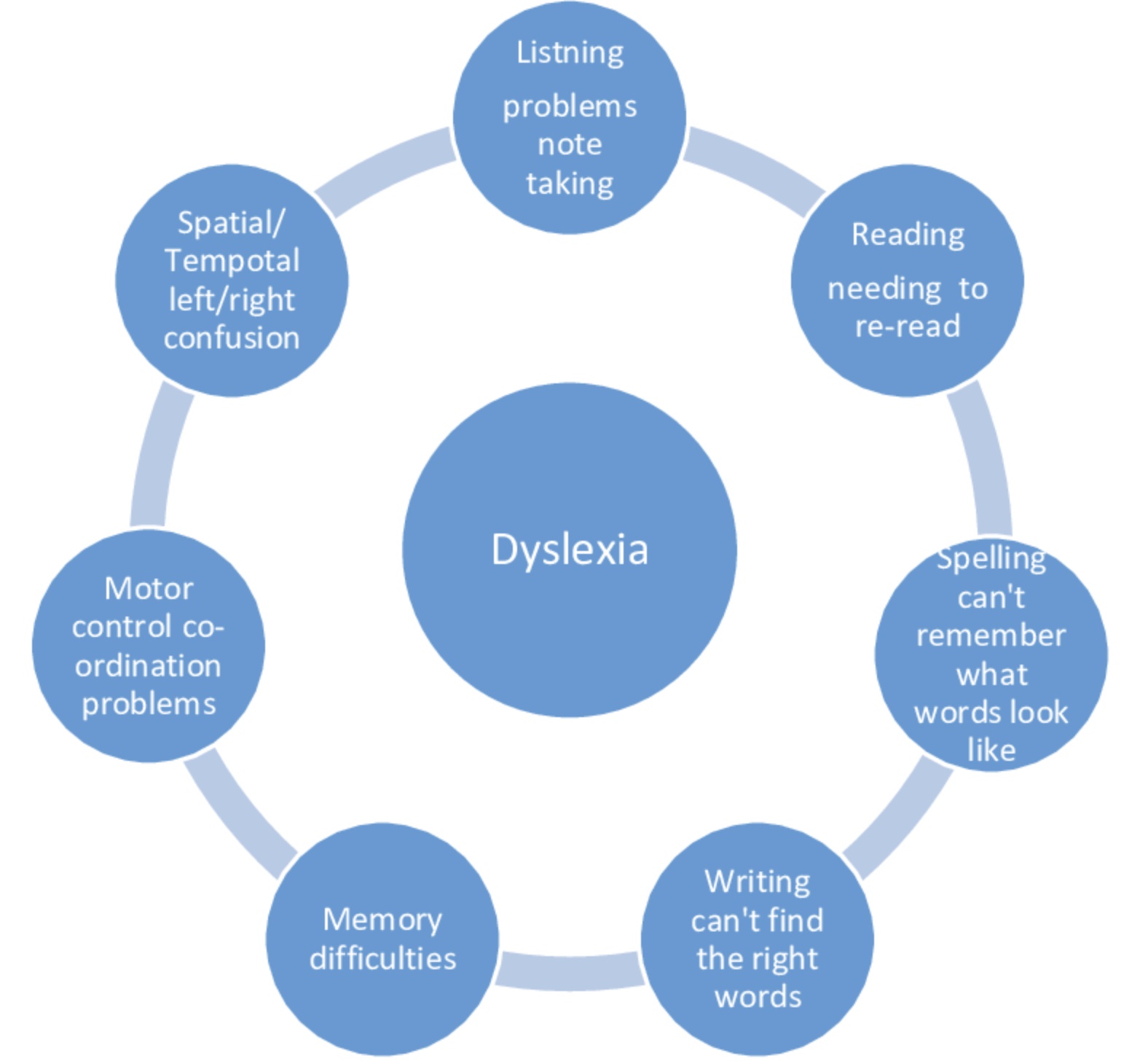
- Reading-intensive courses involving long readings and dense academic text.
- Dense digital text: inaccessible PDFs and cluttered slides that are harder to process than clean, well-structured material.
- Timed exams, which disadvantage dyslexic students independent of their actual knowledge of the subject.
- Heavy writing demands: essays, reports, and note-taking under time pressure.
- Unclear instructions, hidden marking criteria, and ambiguous expectations, which are harder to infer without support.
- High executive-function load from planning, sequencing, and organising multi-stage academic tasks.
4. Barriers Faced by Students
| Barrier type | What it looks like in practice |
|---|---|
| Academic / Learning | Long, dense reading lists with no summary or structure; heavy reliance on independent, unsupported reading. |
| Digital | Inaccessible or cluttered PDFs and slides; small or low-contrast text; documents not compatible with text-to-speech tools. |
| Communication | Instructions given only verbally or only once; ambiguous or hidden marking criteria. |
| Social | Reluctance to disclose due to stigma, especially where dyslexia is not visibly apparent. |
| Assessment | Timed exams that penalise processing speed rather than subject knowledge; heavy, unscaffolded writing demands under time pressure. |
5. Inclusive Teaching Strategies
Before class
- Upload materials early, in a clean, structured, accessible format.
- Provide reading guides or summaries alongside longer reading lists.
During lectures
- Use plain language and break information into clear, manageable chunks.
- Avoid cluttered slides; use sans-serif fonts, left-aligned text, and strong (but not red/green) colour contrast.
- Give instructions in writing as well as verbally.
Group work
- Allow written contribution options alongside spoken discussion, particularly for planning and note-taking roles.
Practical sessions
- Pair verbal instructions with a written step-by-step guide.
Online learning
- Ensure course materials work with text-to-speech tools, and keep page layouts clean and predictable.
Assessment
- Allow varied assessment formats where possible, and provide clear, unambiguous marking criteria in advance.
- Offer extra time as standard for timed assessments, recognising that processing speed, not subject knowledge, is what is otherwise being penalised.
6. Classroom Accommodations
- Extra time for timed assessments and exams.
- Materials provided in advance, in a clean, structured, accessible format.
- Permission to use assistive software (text-to-speech, spelling and grammar tools) in class and in assessment.
- Alternative assessment formats offered as standard where appropriate (oral presentation, extended time, structured templates).
- A named contact for arranging adjustments without needing to disclose repeatedly to each member of staff.
7. Digital Accessibility Considerations
- Use sans-serif fonts (such as Arial or Calibri) and left-aligned text in course materials.
- Avoid red/green colour combinations and low-contrast text.
- Provide captions and transcripts for video and audio content.
- Ensure documents are compatible with text-to-speech and other assistive software, not distributed as locked scans or images.
- Upload materials early and keep the course page structure predictable.
8. Communication Guidelines
| Do | Avoid |
|---|---|
| Give instructions in writing as well as verbally | Rely on a single verbal instruction with no written back-up |
| Use plain, direct language and short sentences | Use dense, jargon-heavy phrasing where a simpler version would do |
| Provide clear, explicit marking criteria in advance | Leave marking expectations implicit or open to interpretation |
| Treat requests for extra time or format changes neutrally | Treat accommodations as a special favour or lowering of standards |
| Offer a private, low-stigma way to discuss support needs | Require a student to explain or justify their diagnosis in front of peers |
9. Environmental Adjustments
- Quiet study spaces available for focused reading and writing work.
- Printed materials available in larger, dyslexia-friendly fonts and layouts where requested.
- Reduced visual clutter in shared teaching spaces and printed handouts.
- Predictable, consistent formatting across course materials so students are not re-learning a new layout each week.
10. Assistive Technologies
| Technology | How and when it helps |
|---|---|
| Text-to-speech software (e.g., Immersive Reader, Read&Write) | Reduces the demand of sustained silent reading of dense text. |
| Grammarly and similar writing-support tools | Supports spelling, grammar, and proofreading during writing tasks. |
| Mind-mapping tools (e.g., MindView, Miro) | Helps with planning and organising ideas visually before writing. |
| Task and planning apps (e.g., Microsoft To Do, Trello, Google Keep) | Externalise planning, sequencing, and deadline tracking to reduce executive-function load. |
| ClaroRead and similar reading-support suites | Combine text-to-speech, word prediction, and formatting support in one tool. |
Real-world example
11. Real-Life Example / Case Study
Case Study: An undisclosed diagnosis and a dense reading list
Farrukh (a composite, illustrative example) was diagnosed with dyslexia at school but does not disclose it at university, having successfully compensated through strong verbal skills. A first-year module sets a long weekly reading list with no summary or guidance on priority readings, and a written exam with no extra time built in. Farrukh spends far longer than his peers keeping up with reading, and underperforms in the timed exam relative to his seminar contributions.
Poor practice
- A long reading list is provided with no structure, priority order, or summary.
- Assessment is entirely timed, with no accommodation route unless a student discloses and provides evidence.
Inclusive practice
- Reading lists are structured with a small number of priority readings clearly marked, alongside optional further reading.
- Materials are provided in accessible, text-to-speech-compatible formats as standard.
- Extra time and alternative assessment formats are available through a simple, private, low-stigma process.
Lessons learned
- Because dyslexia is frequently undisclosed, the most effective changes were built into course design for everyone rather than dependent on a formal diagnosis being shared.
- Structuring reading lists and providing accessible formats reduced the disadvantage without requiring Farrukh to disclose anything.
12. Practical Scenarios
Scenario A
A student’s essays show strong ideas but frequent spelling and grammar errors that affect their grade. What do you do?
- Consider whether an underlying difficulty such as dyslexia might be present, and signpost, without assumption or diagnosis, the option of a confidential conversation with disability support services.
Scenario B
A student asks for a reading list to be prioritised or summarised. What do you do?
- Mark two or three priority readings clearly for the whole class — this benefits time-pressured students broadly, not only those with dyslexia.
Scenario C
A student requests extra time in an exam and a colleague questions whether this is fair to other students. What do you do?
- Explain that extra time addresses processing speed, not subject knowledge, and is there to create equal access to demonstrating what a student knows, not an advantage.
13. Do’s and Don’ts
| Do | Don’t |
|---|---|
| Provide materials in clean, structured, accessible formats | Distribute dense, cluttered slides or scanned documents |
| Give clear marking criteria and instructions in writing | Leave expectations implicit or verbal-only |
| Offer extra time and format flexibility as standard practice | Treat accommodations as a special favour or unfair advantage |
| Structure and prioritise long reading lists | Assign lengthy reading with no guidance on what matters most |
| Keep the option to disclose private and low-stigma | Require a student to justify their needs in front of peers |
14. Lecturer Checklist
- Are my materials in a clean, structured, accessible format (sans-serif font, left-aligned, good contrast)?
- Have I given instructions and marking criteria in writing as well as verbally?
- Is my reading list structured with clear priority readings, rather than one long undifferentiated list?
- Do I allow varied assessment formats and extra time as a standard option, not only on individual request?
- Have I uploaded materials early and kept the course page layout predictable?
15. Student Support / Disability Services Checklist
- Is there a confidential, low-stigma route for a student to discuss a dyslexia diagnosis or seek an assessment?
- Is assistive software (text-to-speech, writing support, mind-mapping tools) available and clearly signposted to all students?
- Are extra time and alternative assessment formats available through a simple, documented process?
- Is there awareness that many dyslexic students are undiagnosed or undisclosed, so course-wide accessible design is being used, not only individual accommodation?
16. Quick Reference Guide
17. Key Takeaways
- Dyslexia primarily affects reading fluency, spelling, working memory, and processing speed — not intelligence or academic potential.
- Dyslexia remains substantially under-diagnosed and under-disclosed in higher education, so accessible design should be built into every course, not offered only on individual request.
- Timed exams and dense, unstructured text disadvantage dyslexic students independent of their actual subject knowledge.
- Real institutional examples (Southampton’s campus-wide assistive software, Kent’s Inclusive Learning Plan) show that structural changes reduce anxiety and improve outcomes, not just individual accommodations.
- Practices that support dyslexic students — clean formatting, structured reading lists, written instructions — improve access for the wider student body as well.
18. References
University of Strathclyde. Barriers faced by students with dyslexia. www.strath.ac.uk/professionalservices/disabilityandwellbeing/informationforstaff/workingwithstudentswithdyslexia/barriersfacedbystudentswithdyslexia/
British Dyslexia Association. Resources for staff and students. www.bdadyslexia.org.uk/resources
University of Southampton. Assistive Software (Read&Write, ClaroRead, MindView). www.southampton.ac.uk/edusupport/study_support/ways_of_support/ats.page
University of Kent. Inclusive Learning Plans. student.kent.ac.uk/support/inclusive-learning-plans
Sections 1, 3, 4, and parts of 10 and 18, draw directly on the Strathclyde and British Dyslexia Association barrier guidance, the Southampton and Kent institutional examples, and the Kiran persona in the project material. Sections 2, 5, 6, 7, 8, 9, 11, 12, 13, 14, 15, and 16 have been newly drafted to complete the standardised 18-part structure, consistent with the cited sources, and should be reviewed by the project team. Dyslexia was one of the thinner topics in the source research, so this chapter required more new drafting than Hearing Impairment, ADHD, Autism, or Visual Impairment.